Reading a Public Statement: Separate the Aim from the Method
Reading a public statement closely helps you separate its stated aim from its proposed method, identify missing details and ask a precise follow-up question.
A notice on the library door says the council will “make the high street safer and more welcoming”. Reading a public statement starts with a practical question: what change does it promise, and what action does it propose? Separating those claims helps you see what the decision is meant to achieve and what still needs explaining.
Start with the occasion
Public statements appear in council announcements, school board letters, ministerial speeches, consultation documents and service leaflets. Before interpreting the wording, note who issued it, who is expected to read it and what event prompted it.
The occasion gives context, not proof of purpose. A message released before a meeting may set out a proposal; a notice issued afterwards may explain a decision. Check dates, named bodies, meeting references and words such as “proposed”, “approved” or “under review”.
In the margin, record speaker, audience and occasion. If any detail is unclear, write “not stated” rather than filling the gap with an assumption.
Identify the stated aim
The aim is the change or public benefit the statement says it wants. It may appear in a headline, opening paragraph or phrase such as “to improve”, “to protect”, “to support” or “to reduce”. Copy the claim in the document’s own words before putting it into everyday language.
Then ask what the aim describes. “Improve access to local services” names a broad direction, but does not say which service, whose access or what improvement would look like. Even a clear aim can leave important choices open.
When a statement bundles aims together, separate them. If it promises cleaner streets, safer crossings and livelier public spaces, note each outcome individually so you can see which proposed action is meant to support each one.
Identify the proposed method
The method is the action or arrangement offered as a way to pursue the aim. Look for verbs and operational details: introduce, fund, change, require, consult, publish, expand or close. Note who is meant to act and whether the statement describes a proposal, a decision or an intention.
Keep action separate from outcome. “Install new lighting” describes a method; “make the route feel safer” describes an intended effect. They are like a recipe’s purpose and ingredients: listing the ingredients tells you what is planned, not whether the result will follow.
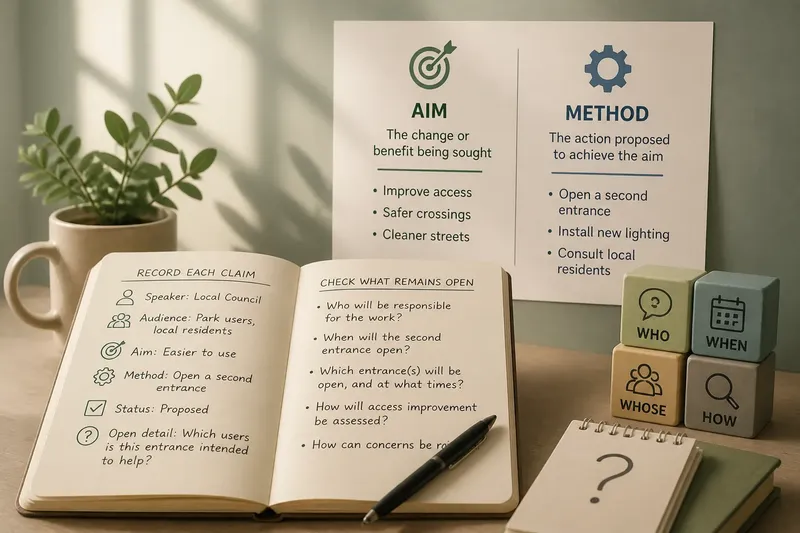
Say you find a fictional local-authority notice that aims to make a park easier to use and proposes opening a second entrance. Record “easier to use” as the aim and “open a second entrance” as the method. The next question is which visitors the entrance is intended to help and how the authority will assess whether access has improved.
Record each claim
Use these checks to separate what the statement says from what you still need to know. For each observation, take the decision shown; if the information is missing, use the alternative action rather than guessing.
- Speaker: Check for a named person or public body; if one is named, record it as the issuer, but if none appears, write “not stated” and check the document’s source.
- Audience: Check for named readers or affected groups; if the statement identifies them, record those groups, but if it uses a broad label such as “the community”, ask which people it includes.
- Aim: Check for a stated change or benefit; if one is clear, copy its wording, but if several are bundled together, list them separately.
- Method: Check for an action, rule or arrangement; if one is specified, record the actor and action, but if no action appears, note that the method is not stated.
- Status: Check for words such as “proposed”, “may” or “approved”; if the status is clear, preserve that wording, but if it is absent, ask whether the statement describes an option or a settled decision.
- Open detail: Check for responsibility, timing, eligibility, scope or a way to raise concerns; if the detail is provided, note where, but if it is missing, write one focused question.
Make each open question answerable. “Will this work?” is too broad. “Which entrances will be open, and at what times?” points to information you can look for in the proposal or ask the issuing body to clarify.
Check what remains open
A statement may leave details for another document or a later decision. Look for information about responsibility, timing, eligibility, scope, cost, progress or how people can raise concerns. An omission is not automatically a fault; the aim is to locate the boundary of this particular statement.
If it names a policy document, meeting paper or contact point, check that source before deciding an answer is absent. If no source is given, record the missing detail as a question rather than supplying your own explanation.
Pay attention to broad labels such as “community”, “users” or “vulnerable residents”. Ask who is included, who may be affected differently and whether the statement explains how those people were considered.
Read commitment verbs
Verbs signal how settled a statement is. “Will introduce” sounds more definite than “plans to consider”; “may provide” leaves more room for change than “has approved”. Preserve those distinctions when you take notes.
Notice who appears as the actor. “A new process will be introduced” does not name the decision-maker or the body responsible for carrying it out. Passive wording is not automatically evasive, but it may leave you with a useful question about accountability.
Keep the original wording beside your paraphrase. Replacing “could” with “will”, or “aims to” with “has delivered”, changes the claim and makes it sound more definite than the source.
Questions about aims and methods?
How can I distinguish an aim from a method?
An aim names the change or benefit being sought; a method names the action proposed to pursue it. If one sentence contains both, make two notes and keep the original wording nearby.
What if a statement names several aims?
List each aim separately and check whether the document links it to a method. If the link is unclear, ask which action is intended to support which aim.
Does persuasive language make a statement unreliable?
Not by itself. Treat confident or emotive wording as a reason to check the aim, method and supporting explanation carefully, not as proof that a claim is false.
What should I do with an unanswered question?
Check any source the statement names, such as a meeting paper or policy note. If the answer remains unclear, ask the issuing body a concise question that quotes the relevant phrase and identifies the detail you need.
Work through a notice
Imagine you are reading a fictional community notice from a borough council. It says the council “aims to improve access to the park” and “proposes a new entrance”, but gives no route or timetable. Start by recording the issuer as the borough council and the aim in the notice’s exact words.
Next, record the method as a proposed new entrance, not as an approved change. The status word “proposes” means the notice presents an option; it does not establish that the entrance will be built. Since no route or timetable is given, write those as missing details rather than assumptions.
Your resulting note could read: “Issuer: borough council; aim: improve access to the park; method: proposed new entrance; status: proposal; open questions: which route will it connect to, and when will a decision be made?” The trade-off is clear: the notice gives a direction and an action, but not enough detail to judge who benefits or when the change might happen.
Write a useful note
A compact record is more useful than a long list of reactions. Write who issued the statement and why, the aim in its own words, the proposed method and the most important unanswered question. Add the source you checked, if there is one.
For a noticeboard discussion, you might write: “Issued by the borough for residents; aim: improve access to the park; method: add an entrance; open question: which route will it connect to?” This gives neighbours a precise starting point without endorsing or rejecting the proposal.
When reading a public statement, keep aim and method in separate notes until the document connects them. A focused question about the actor, status or missing detail can show exactly what the issuing body needs to explain next.