The Secret Ballot: Why Privacy Became Part of Voting
The secret ballot protects a voter’s individual choice while leaving election procedures open to scrutiny. See how that boundary supports representation.
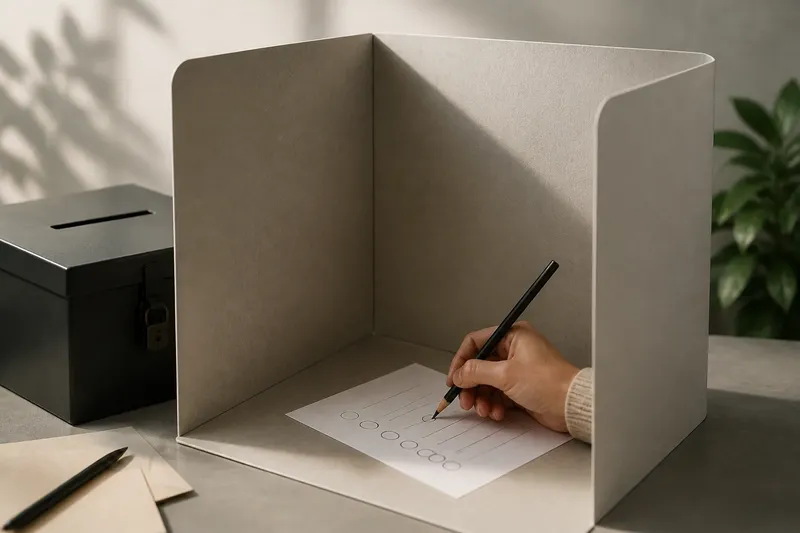
A voter takes a paper ballot, steps behind a screen and marks a choice out of view. The secret ballot makes that small act private while its result contributes to a public decision. Its purpose becomes clearer when we distinguish the voter’s choice from the process used to count it.
Public voting pressures
In some places and periods, voting procedures allowed others to see or hear a voter’s choice. The forms and history of public voting differed across political systems, so there is no single timeline that describes them all. The civic issue is easier to identify than a universal history: when a choice is visible, other people may try to influence it.
A landlord, employer, creditor or family member might expect a particular choice and make the cost of dissent clear. A voter could then weigh a political preference against possible consequences for work, housing, credit or social standing.
An exposed vote can make someone answerable to a person who has no proper role in deciding their political choice. Ballot secrecy addresses that imbalance by separating the act of choosing from the ability to inspect the choice.
Privacy as protection
A secret ballot does not hide voting from public life. The vote still contributes to a collective decision, and election administration can remain open to scrutiny. What remains private is the link between an individual voter and a particular selection.
That boundary lets a person choose without first asking whether the choice will please someone with power over them. A screen around a ballot is like a closed door on a shared building: the private space protects one person’s action, while the result still joins a public process.
Secrecy also makes a voter’s promise harder for another person to verify. That can limit attempts to demand proof of a vote or trade a favour for a particular choice. It cannot remove every kind of pressure, especially pressure applied before voting.
Changing expectations
Arguments about ballot secrecy concern what a vote should express and whether accountability requires an individual choice to be visible. Supporters of open voting may regard a public declaration as a sign of responsibility. Critics point out that exposure can turn a declaration into compliance when a voter depends on someone else.
As different systems adopted secret voting, the practice came to express a boundary between public administration and private judgement. A ballot, a private place to mark it and procedures that keep selections confidential allow officials to count votes without claiming ownership of voters’ reasons.
This boundary matters to representation. A public body is expected to reflect choices across a community, not only the views that people feel safe displaying. Privacy gives voters a way to participate without making their personal vulnerability part of the public record.
Process and voter privacy
Secrecy at the point of voting is not a complete account of free political expression. Intimidation, misinformation, exclusion and pressure outside the polling place can still shape a person’s choices. A private mark cannot resolve every obstacle to participation.
Nor should secrecy put the whole election beyond scrutiny. The public has an interest in understanding how voting is administered and how results are produced. The boundary to protect is between checking the process and exposing each voter’s selection.
- If an eligibility check confirms who may take part without recording their selection, keep the check separate from the ballot; if it links identity to choice, ask the relevant election authority how that link is prevented.
- If ballot papers can be marked out of view, use the private voting space; if the space is exposed or obstructed, ask an election official for an appropriate arrangement.
- If the count can be observed without identifying individual selections, scrutinise the count; if a procedure appears to reveal a voter’s choice, raise the concern with the responsible election authority.
- If a voter is asked to prove how they voted, do not treat a claimed proof as a necessary part of participation; if pressure continues, seek help from an appropriate local election or support service.
- If instructions explain how a local voting method protects confidentiality, follow those instructions; if they are unclear, consult the election authority responsible for that vote.
- If an observer can check that procedures are followed without seeing marked ballots individually, preserve that distinction; if observation exposes choices, ask officials to adjust the arrangement under local rules.
Rules differ between voting systems. For practical questions about a particular election, consult the relevant election authority’s instructions and local rules.
Why does ballot privacy matter?
Is voting entirely private?
No. A vote contributes to a public decision, and election administration can be scrutinised. Privacy concerns the individual’s marked choice, not the existence or conduct of the process.
Why not make every vote visible?
Visibility may reveal a choice, but it can also give others leverage over the voter. Scrutiny can instead focus on whether procedures are fair and results are handled properly.
Can secrecy prevent pressure?
It can make a choice harder to monitor or enforce. It cannot by itself remove threats, dependency or social expectations that arise before a person votes.
How does secrecy support representation?
It lets voters register a choice without displaying agreement with a powerful person or group. That boundary can help representation reflect individual judgement as well as publicly expressed views.
Privacy in practice
Say an invented town’s supervisor asks a worker to report their vote. The worker uses a private ballot, follows the polling-place instructions and leaves without disclosing the selection. The observable result is that the supervisor cannot confirm the choice from the marked ballot, although the scenario does not remove pressure outside the polling place.
The secret ballot connects an individual’s freedom with collective decision-making. When considering ballot privacy, ask whether the process can be checked without exposing a voter’s selection. That is the practical boundary that lets a secret ballot support both public accountability and personal political judgement.